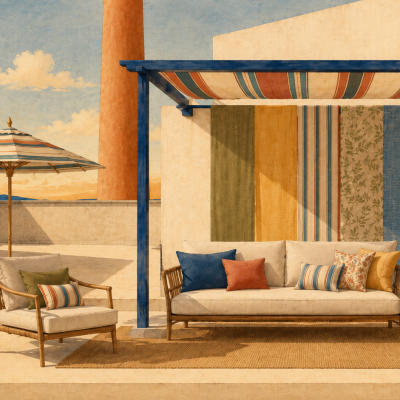
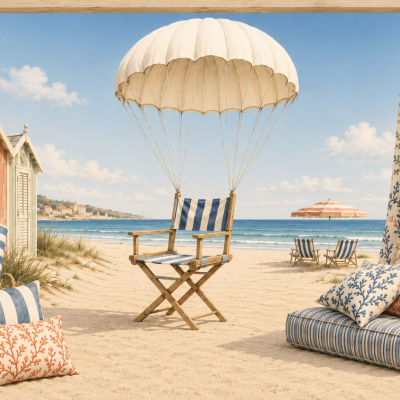
If last year’s Milan Design Week made one thing clear, it is that textiles are no longer simply presented: they are staged.
No longer simple hanging collections or neatly arranged sample books, but true immersive events, where fabric becomes a physical, narrative, almost cinematic experience.
One of the most iconic examples was Dedar, which took over Torre Velasca with Weaving Anni Albers. Going up to the upper floors of the building meant entering a suspended dimension, where fabrics — inspired by the work of the renowned artist — interacted with light and with the city. There was no set path: it was a free exploration of surfaces, weaves and transparencies. An installation that transformed textiles into temporary architecture.
Completely different, yet equally powerful, was the experience by Loro Piana Interiors. During Design Week, the brand opened the doors to spaces conceived as sensory refuges: soft, silent environments where every element invited contact. More than looking, visitors were encouraged to touch, to sit, to slow down. Here, luxury was not displayed, but perceived — made of the purest materials and an extremely carefully calibrated direction.
Ralph Lauren Home, on the other hand, played on yet another register: storytelling. The brand transformed its Milan spaces into a true extension of its own imaginary world, between timeless elegance and cinematic suggestions. Fabrics, furnishing pieces and accessories helped create complete environments, almost as if they were lived-in sets. Not an exhibition, but a coherent narrative, where every detail — from textures to patterns — reinforced the brand’s identity.
These events tell the story of a precise transformation: textiles are no longer products to be observed, but a medium to be experienced.
The way collections are designed also reflects this shift in pace. Surfaces are becoming increasingly complex, conceived to react to light, to create depth and to be perceived in motion. Textured bouclés, three-dimensional jacquards, vibrant velvets: every fabric is designed to activate a sensory relationship.
And then there is the question of atmosphere. The events of the last Design Week demonstrated it clearly: textiles are one of the most powerful tools for shaping interiors. They filter light, absorb sound and define comfort. In one word, they create experience.
Looking at what we saw in 2025, it is difficult to imagine a return to simple display. The future — already very much present — is made of installations, cross-pollinations and immersive narratives. And fabric, now more than ever, is the silent protagonist of this evolution.